Why Groceries Feel So Expensive When Inflation Has Cooled
I'm a slow grocery shopper. I like it, mostly. Looking at new products, deciding what to cook that week, picking out a watermelon. Last month I spent a while in the cereal aisle and got stuck in front of Honey Nut Cheerios.
$8.79. $0.43 an ounce.
I grimaced and put it back. My gut said: inflation, greed, gouging.
Then I was at Aldi and saw their version (Honey Nut Crispy Oats) for around $3.15, or $0.16 an ounce. Still muttering to myself about Harris Teeter. Then I was at Costco. Their Kirkland version: $0.10 an ounce. Six cents cheaper than Aldi. Less than a quarter of the Harris Teeter price.
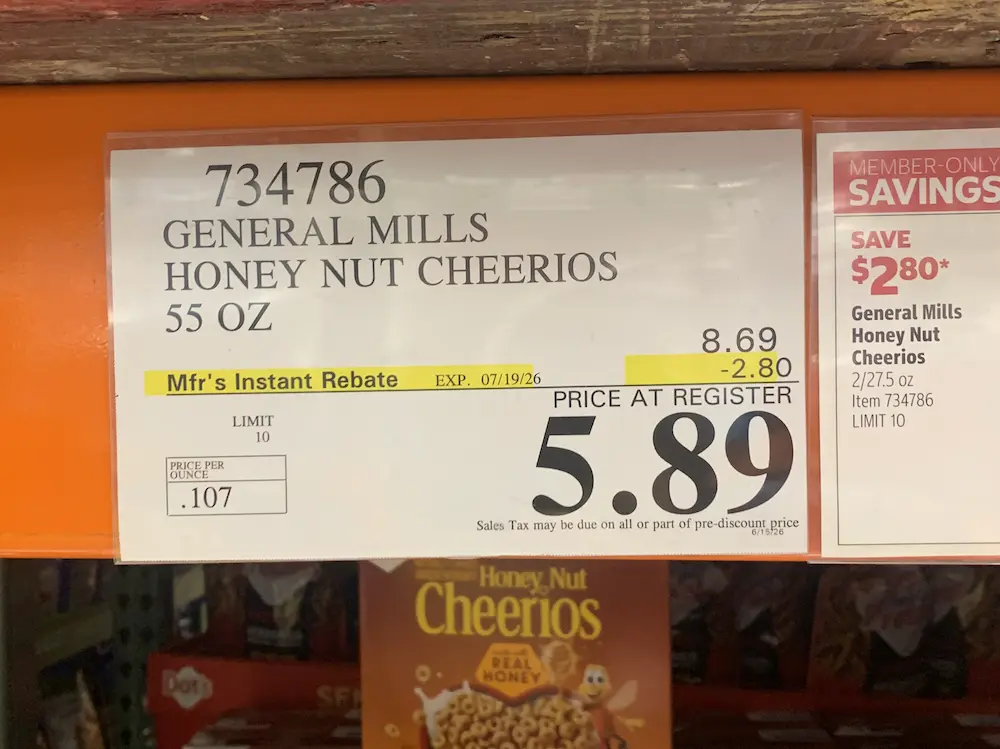
That's where the gouging story stopped making sense.
If Harris Teeter were price gouging (using market power to extract money from people with no other option) Aldi couldn't exist three miles away at 36% of the price. Costco couldn't exist at 23%. Gouging needs a captive audience. I'm not captive. I drove somewhere else and the price went back down to earth. And if it was General Mills gouging, then the $0.10 Costco price wouldn't make sense either.
So either Harris Teeter is the least effective monopolist in history, or something else is going on.
Not gouging, fine. But I'm still looking at an $8.79 price tag, and I still don't really understand where that's coming from.
The two obvious places to look: the ingredients, and what Cheerios cost over time. If something's running away from us, one of those should show it.
Oat commodity prices wobble. They spiked in 2022, then came back down and have been sitting roughly where they've sat for years.
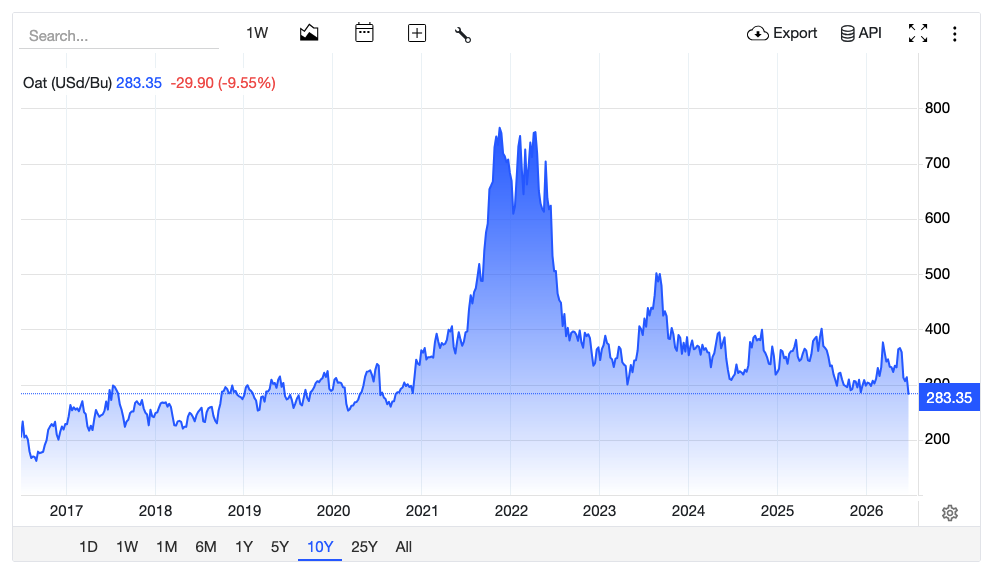
More to the point, the oats in a box of Cheerios are a rounding error on the shelf price. Even at the 2022 peak, you're talking about the difference between a few cents and a few more cents. The ingredient cost theory (i.e. everything's expensive because their costs went up) doesn't hold. Their costs didn't go up in any way that gets you to $8.79.
What about the product itself? Maybe Cheerios has been quietly getting more expensive and I just hadn't noticed.
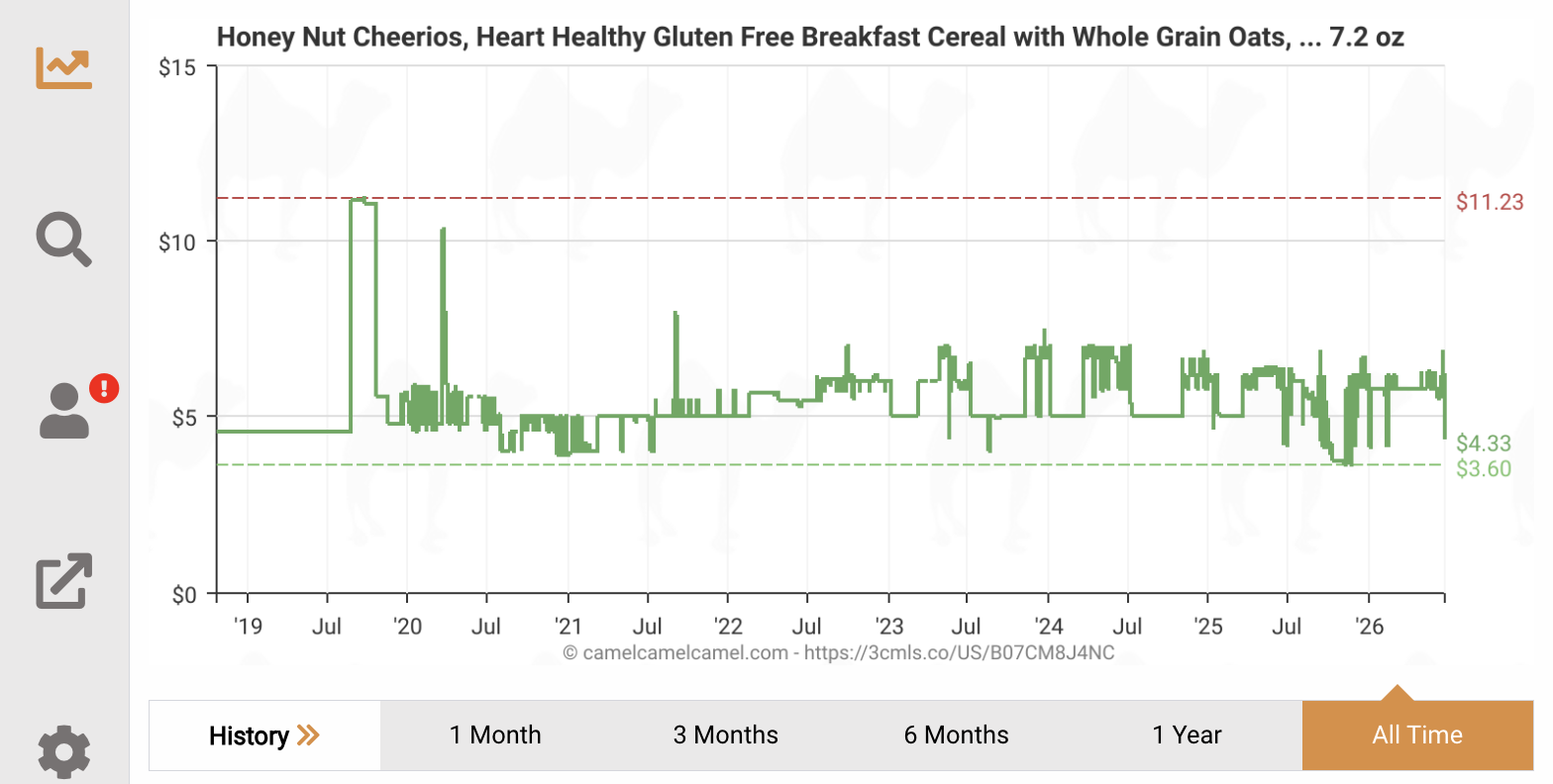
This is the Amazon price history going back to 2019. It's mostly flat. There was a step-up around 2020 into a higher band, and then the same rough price from 2022 to now. Harris Teeter's price is a premium on top of that (more than double per ounce) but the underlying product hasn't been climbing.
At this point in my investigation, I'm feeling highly gaslit. $8.79 is expensive. But this isn't a new thing? So why does it feel new?
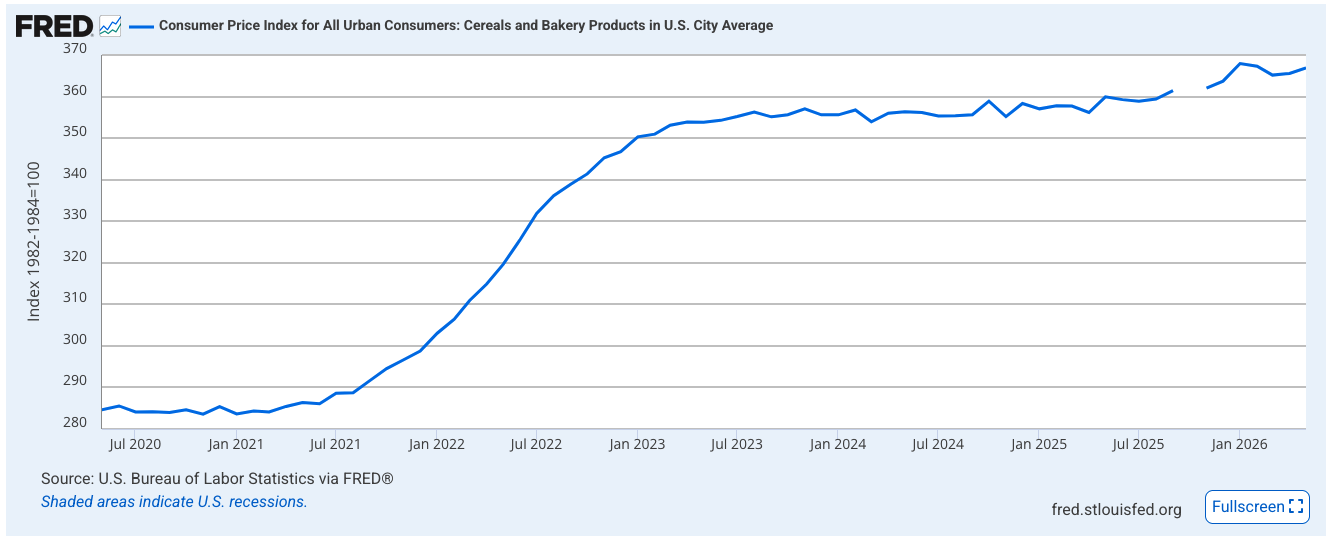
The CPI chart for cereals and bakery products is what settled it for me. Between mid-2021 and early 2023, the whole category jumped around 25% in 18 months. Prices went up hard and fast, then stopped. From early 2023 to now, the line is pretty much flat.
The inflation happened, ended, and left prices at a new higher level.
That's what I was missing in the cereal aisle. My gut wasn't wrong that something happened. Something did happen. It just happened three years ago. By the time I was standing there staring at that box, the movement was long over.
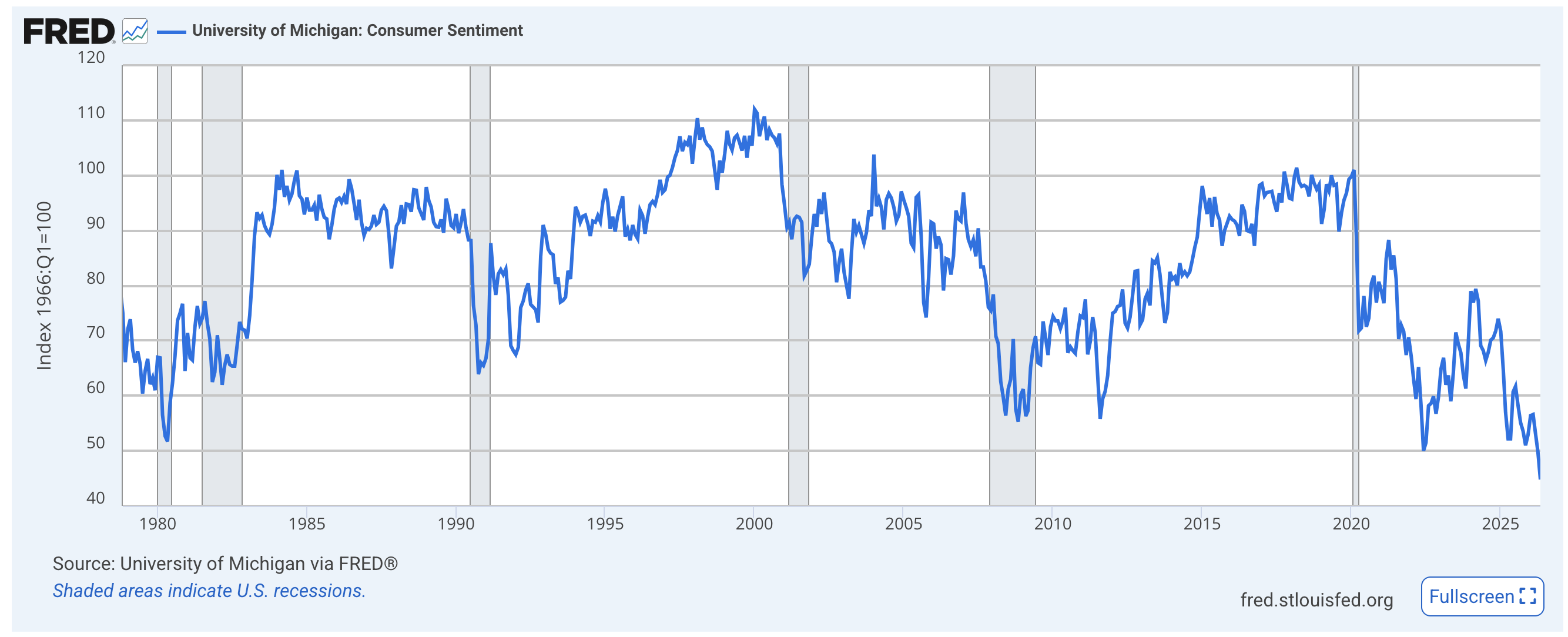
And I know I'm not alone here. Consumer sentiment right now is at an all-time low, even though CPI has been flat for three years.
My grand conclusion is that nothing has happened recently. I think we bought into the line of "blah blah supply chain blah blah" that was used to justify the price increases and, unsurprisingly, prices never ratcheted back down.
That's what I think the sentiment data is capturing. It's not a new thing. It's not a new pricing effort from Harris Teeter or General Mills. But, now we have millions of people separately doing their own version of grimacing in the cereal aisle. Inflation already happened. The prices stopped moving years ago, but the feelings about them are still catching up.
I'm left wondering why sentiments may lag behind inflation. One thought is that when we hear everyone applauding that inflation is back to normal, that means that the rate of inflation is back to normal. That doesn't have anything to do with the new level that we reached after a period of high inflation. For example, if we plug the hull of a ship, should we celebrate that the water leak has slowed? Or, are we looking around at the water that's risen to our necks?
Maybe it's the permanence? Like, I don't know what "blah blah supply chain blah blah" could've meant, but it sounded temporary in the moment. After years of higher prices across the board, maybe folks are just feeling reality set in.
Maybe consumer sentiment is a flawed metric that doesn't capture the reality of our economy. There are totally reasonable arguments to be had around the quality of this data, especially as we become increasingly politically polarized. I think that I am wildly biased by the data -- the very fact that the chart says that we're at an all-time low definitely primed me to be fired up seeing the $8.79 price tag.